

The Verilog-to-Routing (VTR) project is a world-wide collaborative effort to provide an open-source framework for conducting FPGA architecture and CAD research and development. The VTR design flow takes as input a Verilog description of a digital circuit, and a description of the target FPGA architecture. It then performs:
- Elaboration, Synthesis & Partial Mapping (PARMYS)
- Logic Optimization & Technology Mapping (ABC)
- Packing, Placement, Routing & Timing Analysis (VPR)
to generate FPGA speed and area results. VTR includes a set of benchmark designs known to work with the design flow.
VTR can also produce FASM to program some commercial FPGAs (via Symbiflow)
| Placement (carry-chains highlighted) | Critical Path |
|---|---|
 |
 |
| Logical Connections | Routing Utilziation |
|---|---|
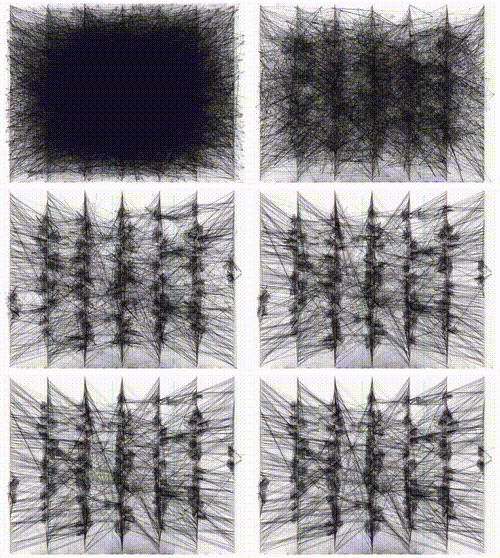 |
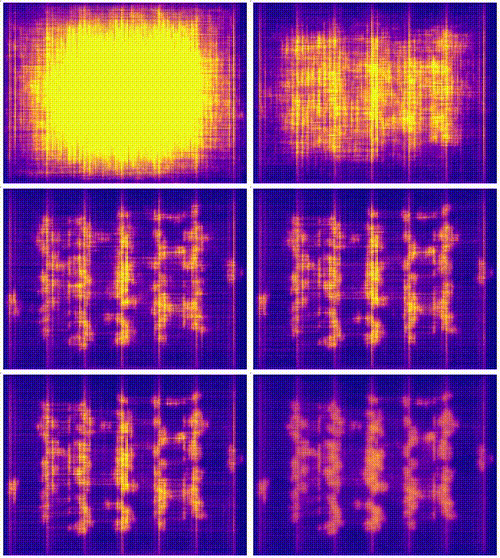 |
VTR's full documentation includes tutorials, descriptions of the VTR design flow, and tool options.
Also check out our additional support resources.
Generally most code is under MIT license, with the exception of ABC which is distributed under its own (permissive) terms. See the full license for details.
The following paper may be used as a general citation for VTR:
K. E. Murray, O. Petelin, S. Zhong, J. M. Wang, M. ElDafrawy, J.-P. Legault, E. Sha, A. G. Graham, J. Wu, M. J. P. Walker, H. Zeng, P. Patros, J. Luu, K. B. Kent and V. Betz "VTR 8: High Performance CAD and Customizable FPGA Architecture Modelling", ACM TRETS, 2020.
Bibtex:
@article{vtr8,
  title={VTR 8: High Performance CAD and Customizable FPGA Architecture Modelling},
  author={Murray, Kevin E. and Petelin, Oleg and Zhong, Sheng and Wang, Jai Min and ElDafrawy, Mohamed and Legault, Jean-Philippe and Sha, Eugene and Graham, Aaron G. and Wu, Jean and Walker, Matthew J. P. and Zeng, Hanqing and Patros, Panagiotis and Luu, Jason and Kent, Kenneth B. and Betz, Vaughn},
  journal={ACM Trans. Reconfigurable Technol. Syst.},
  year={2020}
}
For most users of VTR (rather than active developers) you should download the latest official VTR release, which has been fully regression tested.
On unix-like systems run make from the root VTR directory.
For more details see the building instructions.
We provide a Dockerfile that sets up all the necessary packages for VTR to run. For more details see here.
If you have questions, or want to keep up-to-date with VTR, consider joining our mailing lists:
VTR-Announce: VTR release announcements (low traffic)
VTR-Users: Discussions about using VTR
VTR-Devel: Discussions about VTR development
VTR-Commits: VTR revision control commits
This is the development trunk for the Verilog-to-Routing project. Unlike the nicely packaged releases that we create, you are working with code in a constant state of flux. You should expect that the tools are not always stable and that more work is needed to get the flow to run.
For new developers, please follow the quickstart guide.
We follow a feature branch flow, where you create a new branch for new code, test it, measure its Quality of Results, and eventually produce a pull request for review by other developers. Pull requests that meet all the quality and review criteria are then merged into the master branch by a developer with the authority to do so.
In addition to measuring QoR and functionality automatically on pull requests, we do periodic automated testing of the master using BuildBot, and the results can be viewed below to track QoR and stability.
IMPORTANT: A broken build must be fixed at top priority. You break the build if your commit breaks any of the automated regression tests.
For additional information see the developer README.
If you'd like to contribute to VTR see our Contribution Guidelines.
Please keep this up-to-date
Professors: Kenneth Kent, Vaughn Betz, Jonathan Rose, Jason Anderson, Peter Jamieson
Research Assistants: Aaron Graham
Graduate Students: Kevin Murray, Jason Luu, Oleg Petelin, Xifian Tang, Mohamed Elgammal, Mohamed Eldafrawy, Jeffrey Goeders, Chi Wai Yu, Andrew Somerville, Ian Kuon, Alexander Marquardt, Andy Ye, Wei Mark Fang, Tim Liu, Charles Chiasson, Panagiotis (Panos) Patros, Jean-Philippe Legault, Aaron Graham, Nasrin Eshraghi Ivari, Maria Patrou, Scott Young, Sarah Khalid, Seyed Alireza Damghani, Harpreet Kaur, Daniel Khadivi, Alireza Azadi
Summer Students: Opal Densmore, Ted Campbell, Cong Wang, Peter Milankov, Scott Whitty, Michael Wainberg, Suya Liu, Miad Nasr, Nooruddin Ahmed, Thien Yu, Long Yu Wang, Matthew J.P. Walker, Amer Hesson, Sheng Zhong, Hanqing Zeng, Vidya Sankaranarayanan, Jia Min Wang, Eugene Sha, Jean-Philippe Legault, Richard Ren, Dingyu Yang, Alexandrea Demmings, Hillary Soontiens, Julie Brown, Bill Hu, David Baines, Mahshad Farahani, Helen Dai, Daniel Zhai
Companies: Intel, Huawei, Lattice, Altera Corporation, Texas Instruments, Google, Antmicro
Funding Agencies: NSERC, Semiconductor Research Corporation


