python-creole is a OpenSource (GPL) Python lib for converting markups. python-creole is pure python. No external libs needed.
Compatible Python Versions (see tox config in pyproject.toml):
- 3.9, 3.8, 3.7
- PyPy3
Existing converters:
- creole -> html
- html -> creole markup
- reSt -> html (for clean html code)
- html -> reStructuredText markup (only a subset of reSt supported)
- html -> textile markup (not completed yet)
- html -> markdown markup
The creole2html part based on the creole markup parser and emitter from the MoinMoin project by Radomir Dopieralski and Thomas Waldmann.
 | |
 | coveralls.io/r/jedie/python-creole |
 | landscape.io/github/jedie/python-creole/master |
 | pypi.org/project/python-creole/ |
Python packages available on: http://pypi.python.org/pypi/python-creole/
~$ pip install python-creole
To setup a virtualenv via Poetry, see unittests section below.
Convert creole markup to html code:
>>> from creole import creole2html
>>> creole2html("This is **creole //markup//**")
'<p>This is <strong>creole <i>markup</i></strong></p>\n'Convert html code back into creole markup:
>>> from creole import html2creole
>>> html2creole('<p>This is <strong>creole <i>markup</i></strong></p>\n')
'This is **creole //markup//**'Convert ReStructuredText into clean html code (needs docutils):
>>> from creole.rest2html.clean_writer import rest2html
>>> rest2html(u"A ReSt link to `PyLucid CMS <http://www.pylucid.org>`_ :)")
'<p>A ReSt link to <a href="http://www.pylucid.org">PyLucid CMS</a> :)</p>\\n'
(more information: rest2html wiki page)
Convert html code into ReStructuredText markup:
>>> from creole import html2rest
>>> html2rest('<p>This is <strong>ReStructuredText</strong> <em>markup</em>!</p>')
'This is **ReStructuredText** *markup*!'Convert html code into textile markup
>>> from creole import html2textile
>>> html2textile('<p>This is <strong>textile <i>markup</i></strong>!</p>')
'This is *textile __markup__*!'
See also: http://github.com/jedie/python-creole/blob/master/demo.py
Convert html code into textile markup
>>> from creole import html2markdown
>>> html2markdown('<p>This is <strong>markdown <i>markup</i></strong>!</p>')
'This is **markdown _markup_**!'
See also: http://github.com/jedie/python-creole/blob/main/demo.py
You can pass image width/height in image tags, e.g.:
>>> from creole import creole2html
>>> creole_markup="""{{foobar.jpg|image title|90x160}}"""
>>> creole2html(creole_markup)
'<p><img src="foobar.jpg" title="image title" alt="image title" width="90" height="160" /></p>'
The third part (90x160) is not in creole standard, you can force a strict mode, e.g.:
>>> creole2html(creole_markup, strict=True)
'<p><img src="foobar.jpg" title="image title|90x160" alt="image title|90x160" /></p>'
You can find a example macro which highlight source code thanks to the pygments library. It is located here: /creole/shared/example_macros.py. Here is how to use it:
>>> from creole import creole2html
>>> from creole.shared.example_macros import code
>>> creole_markup="""<<code ext=".py">>#some code\nprint('coucou')\n<</code>>"""
>>> creole2html(creole_markup, macros={'code': code})If you have python-creole installed, you will get these simple CLI scripts:
- creole2html
- html2creole
- html2rest
- html2textile
- html2markdown
Here the --help output from html2creole:
$ html2creole --help
usage: html2creole [-h] [-v] [--encoding ENCODING] sourcefile destination

python-creole is an open-source (GPL) markup converter in pure Python for:
creole2html, html2creole, html2ReSt, html2textile

positional arguments:
  sourcefile           source file to convert
  destination          Output filename

optional arguments:
  -h, --help           show this help message and exit
  -v, --version        show program's version number and exit
  --encoding ENCODING  Codec for read/write file (default encoding: utf-8)
Example to convert a html file into a creole file:
$ html2creole foobar.html foobar.creole
We store documentation/examples into the project wiki:
How to handle unknown html tags in html2creole:
Contributers should take a look at this page:
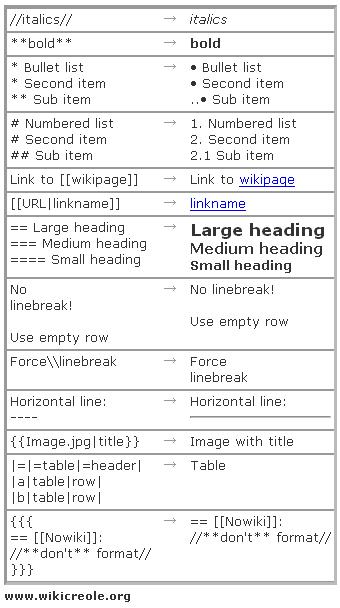
Creole Markup Cheat Sheet can be found here: http://www.wikicreole.org/wiki/CheatSheet
# clone repository (or use your fork):
~$ git clone https://github.com/jedie/python-creole.git
~$ cd python-creole

# install or update poetry:
~/python-creole$ make install-poetry

# install python-creole via poetry:
~/python-creole$ make install

# Run pytest:
~/python-creole$ make pytest

# Run pytest via tox with all environments:
~/python-creole$ make tox
To see all make targets, just call make:
~/python-creole$ make
help                 List all commands
install-poetry       install or update poetry
install              install python-creole via poetry
update               Update the dependencies as according to the pyproject.toml file
lint                 Run code formatters and linter
fix-code-style       Fix code formatting
tox-listenvs         List all tox test environments
tox                  Run pytest via tox with all environments
pytest               Run pytest
update-readmes       update README.rst and README.md from README.creole
publish              Release new version to PyPi
With python-creole you can convert a README on-the-fly from creole into ReStructuredText in setup.py How to do this, read: https://github.com/jedie/python-creole/wiki/Use-In-Setup
Note: In this case you must install docutils! See above.
- *dev*
- TBC
- v1.5.0.rc3 - 2022-08-20
- NEW: html2markdown
- creole2html bugfixes:
- replace wrong <tt> with <code>
- Add newline after lists
- Remove deprecated "parser_kwargs" and "emitter_kwargs"
- Rename git master branch to main.
- v1.4.10 - 2021-05-11
- Update some string formatting to f-strings
- Replace some join() list comprehension with generators
- Test on github actions also under MacOS
- Remove Travis CI (All tests already running via github actions)
- v1.4.9 - 2020-11-4
- Add missing classifier for Python 3.9 (Contributed by jugmac00)
- Update readme test
- v1.4.8 - 2020-10-17 - compare v1.4.7...v1.4.8
- Validate generated README.rst with readme-renderer
- v1.4.7 - 2020-10-17 - compare v1.4.6...v1.4.7
- update_rst_readme() will touch README.rst if there are not change (timestamp will not changed in file)
- Run tests with Python 3.9, too.
- Some meta updates to project setup
- v1.4.6 - 2020-02-13 - compare v1.4.5...v1.4.6
- less restricted dependency specification
- v1.4.5 - 2020-02-13 - compare v1.4.4...v1.4.5
- new: creole.setup_utils.assert_rst_readme for project setup tests
- use https://github.com/ymyzk/tox-gh-actions on gitlab CI
- v1.4.4 - 2020-02-07 - compare v1.4.3...v1.4.4
- Fix #44: Move poetry-publish to dev-dependencies and lower docutils requirement to ^0.15
- some code style updated
- Always update README.rst before publish
- v1.4.3 - 2020-02-01 - compare v1.4.2...v1.4.3
- Use new poetry-publish for make publish
- v1.4.2 - 2020-02-01 - compare v1.4.1...v1.4.2
- Update CI configs on github and travis
- Update Makefile: add make publish and make update-rst-readme
- Add generated README.rst in repository to fix install problems about missing readme
- v1.4.1 - 2020-01-19 - compare v1.4.0...v1.4.1
- Remove Python v2 support code
- Fix "Undefined substitution referenced" error contributed by dforsi
- Fix regression in tests for setup_utils contributed by jugmac00
- Fix code style with: autopep8
- sort imports with isort
- change old %-formatted and .format(...) strings into Python 3.6+'s f-strings with flynt
- Activate linting in CI pipeline
- v1.4.0 - 2020-01-19 - compare v1.3.2...v1.4.0
- modernize project:
- use poetry
- Add a Makefile
- use pytest and tox
- remove Python v2 support
- Test with Python v3.6, v3.7 and v3.8
- modernize project:
- v1.3.2 - 2018-02-27 - compare v1.3.1...v1.3.2
- Adding optional img size to creole2html and html2creole contributed by John Dupuy
- run tests also with python 3.5 and 3.6
- v1.3.1 - 2015-08-15 - compare v1.3.0...v1.3.1
- Bugfix for "Failed building wheel for python-creole"
- v1.3.0 - 2015-06-02 - compare v1.2.2...v1.3.0
- Refactory internal file structure
- run unittests and doctests with nose
- Refactor CLI tests
- skip official support for Python 2.6
- small code cleanups and fixes.
- use json.dumps() instead of repr() in some cases
- v1.2.2 - 2015-04-05 - compare v1.2.1...v1.2.2
- Bugfix textile unittests if url scheme is unknown
- migrate google-code Wiki to github and remove google-code links
- v1.2.1 - 2014-09-14 - compare v1.2.0...v1.2.1
- Use origin PyPi code to check generated reStructuredText in setup.py
- Update unitest for textile v2.1.8
- v1.2.0 - 2014-05-15 - compare v1.1.1...v1.2.0
- NEW: Add <<code>> example macro (Source code highlighting with pygments) - implemented by Julien Enselme
- NEW: Add <<toc>> macro to create a table of contents list
- Bugfix for: AttributeError: 'CreoleParser' object has no attribute '_escaped_char_repl'
- Bugfix for: AttributeError: 'CreoleParser' object has no attribute '_escaped_url_repl'
- API Change: Callable macros will raise a TypeError instead of create a DeprecationWarning (Was removed in v0.5)
- v1.1.1 - 2013-11-08
- Bugfix: Setup script exited with error: can't copy 'README.creole': doesn't exist or not a regular file
- v1.1.0 - 2013-10-28
- NEW: Simple commandline interface added.
- v1.0.7 - 2013-08-07
- Bugfix in 'clean reStructuredText html writer' if docutils => v0.11 used.
- Bugfix for PyPy 2.1 usage
- v1.0.6 - 2012-10-15
- Security fix in rest2html: Disable "file_insertion_enabled" and "raw_enabled" as default.
- v1.0.5 - 2012-09-03
- made automatic protocol links more strict: Only whitespace before and at the end are allowed.
- Bugfix: Don't allow ftp:/broken (Only one slash) to be a link.
- v1.0.4 - 2012-06-11
- html2rest: Handle double link/image substitution and raise better error messages
- Bugfix in unittests (include test README file in python package). Thanks to Wen Heping for reporting this.
- v1.0.3 - 2012-06-11
- Bugfix: AttributeError: 'module' object has no attribute 'interesting_cdata' from HTMLParser patch. Thanks to Wen Heping for reporting this.
- Fix a bug in get_long_description() ReSt test for Py3k and his unittests.
- Use Travis CI, too.
- v1.0.2 - 2012-04-04
- Fix "AttributeError: 'NoneType' object has no attribute 'parent'" in html2creole.
- v1.0.1 - 2011-11-16
- Fix "TypeError: expected string or buffer" in rest2html.
- Bugfix in exception handling.
- v1.0.0 - 2011-10-20
- Change API: Replace 'parser_kwargs' and 'emitter_kwargs' with separate arguments. (More information on API Wiki Page)
- v0.9.2
- Turn zip_safe in setup.py on and change unittests API.
- v0.9.1
- Many Bugfixes, tested with CPython 2.6, 2.7, 3.2 and PyPy v1.6
- v0.9.0
- Add Python v3 support (like http://python3porting.com/noconv.html strategy)
- move unittests into creole/tests/
- Tested with Python 2.7.1, 3.2 and PyPy v1.6.1 15798ab8cf48 jit
- v0.8.5
- Bugfix in html2creole: ignore links without href
- v0.8.4
- Bugfix in html parser if list tag has attributes: https://code.google.com/p/python-creole/issues/detail?id=19#c4
- v0.8.3
- Better error message if given string is not unicode: https://code.google.com/p/python-creole/issues/detail?id=19
- v0.8.2
- Bugfix in get_long_description() error handling (local variable 'long_description_origin' referenced before assignment)
- v0.8.1
- Bugfix for installation under python 2.5
- Note: setup helper changed: rename GetLongDescription(...) to get_long_description(...)
- v0.8
- New GetLongDescription() helper for setup.py, see: https://github.com/jedie/python-creole/wiki/Use-In-Setup
- v0.7.3
- Bugfix in html2rest:
- table without <th> header
- new line after table
- create reference hyperlinks in table cells intead of embedded urls.
- Don't always use raise_unknown_node()
- Add child content to raise_unknown_node()
- Bugfix in html2rest:
- v0.7.2
- Activate ---- to <hr> in html2rest
- Update demo.py
- v0.7.1
- Bugfix if docutils are not installed
- API change: rest2html is now here: from creole.rest2html.clean_writer import rest2html
- v0.7.0
- NEW: Add a html2reStructuredText converter (only a subset of reSt supported)
- v0.6.1
- Bugfix: separate lines with one space in "wiki style line breaks" mode
- v0.6
- NEW: html2textile converter
- some API changed!
- v0.5
- API changed:
- Html2CreoleEmitter optional argument 'unknown_emit' takes now a callable for handle unknown html tags.
- No macros used as default in creole2html converting.
- We remove the support for callable macros. Only dict and modules are allowed.
- remove unknown html tags is default behaviour in html2creole converting.
- restructure and cleanup sourcecode files.
- API changed:
- v0.4
- only emit children of empty tags like div and span (contributed by Eric O'Connell)
- remove inter wiki links and doesn't check the protocol
- v0.3.3
- Use <tt> when {{{ ... }}} is inline and not <pre>, see: PyLucid Forum Thread
- Bugfix in html2creole: insert newline before new list. TODO: apply to all block tags: issues 16
- v0.3.2
- Bugfix for spaces after Headline: issues 15
- v0.3.1
- Make argument 'block_rules' in Parser() optional
- v0.3.0
- creole2html() has the optional parameter 'blog_line_breaks' to switch from default blog to wiki line breaks
- v0.2.8
- bugfix in setup.py
- v0.2.7
- handle obsolete non-closed <br> tag
- v0.2.6
- bugfix in setup.py
- Cleanup DocStrings
- add unittests
- v0.2.5
- creole2html: Bugfix if "--", "//" etc. stands alone, see also: issues 12
- Note: bold, italic etc. can't cross line any more.
- v0.2.4
- creole2html: ignore file extensions in image tag
- see also: issues 7
- creole2html: ignore file extensions in image tag
- v0.2.3
- html2creole bugfix/enhanced: convert image tag without alt attribute:
- see also: issues 6
- Thanks Betz Stefan alias 'encbladexp'
- html2creole bugfix/enhanced: convert image tag without alt attribute:
- v0.2.2
- html2creole bugfix: convert <a href="/url/">Search & Destroy</a>
- v0.2.1
- html2creole bugfixes in:
- converting tables: ignore tbody tag and better handling p and a tags in td
- converting named entity
- html2creole bugfixes in:
- v0.2
- remove all django template tag stuff: issues 3
- html code always escaped
- v0.1.1
- improve macros stuff, patch by Vitja Makarov: issues 2
- v0.1.0
- first version cut out from PyLucid CMS
first source code was written 27.11.2008: Forum thread (de)
| GitHub | https://github.com/jedie/python-creole |
| Wiki | https://github.com/jedie/python-creole/wiki |
| PyPi | https://pypi.org/project/python-creole/ |